The Real Cost of SMSF Setup and Annual Audits: Flat-Fee vs. Percentage Pricing
Posted Today


Posted Today
“So… how much does an SMSF actually cost me?” It’s hands-down the most common
question we get from trustees, and the honest answer is: it depends on who you ask – and, crucially, on how they charge you.
Let’s cut through the noise and put some real numbers on the table.
Establishing an SMSF is a one-off event. The big decision is whether to run individual trustees or a corporate trustee (a company that acts as trustee). A corporate trustee costs a little more upfront but is cleaner for adding/removing members, borrowing, succession planning and asset protection – which is why we usually recommend it.
| Set-up item |
Individual trustees |
Corporate trustee |
| SMSF trust deed |
$2,000 – $2,500 |
$3,000 – $3,500 |
| Trustee company (ASIC registration) |
N/A |
~$597 |
| ABN, TFN & ESA registration |
Included |
Included |
| Typical all-up set-up |
~$2,000 – $2,500 |
~$3,597 – $4,097 |
Indicative ranges only – your actual quote will depend on complexity.
This is where the ongoing relationship lives and herein lies the value of a good SMSF accountant. Every SMSF must prepare financial statements and a tax return, and – by law – be audited by an independent SMSF auditor every single year. Add a couple of regulator charges and you’ve got your annual running cost.
| Annual item |
Indicative cost |
Notes |
| Accounting & annual tax return |
$2,000 – $3,000 |
The bulk of the fee |
| Independent SMSF audit |
$600 – $900 |
Compulsory every year |
| ATO SMSF supervisory levy |
$259 |
Fixed, paid via the return |
| ASIC annual review (corporate trustee) |
~$67 |
Special-purpose company |
| Actuarial certificate (if paying a pension) |
$450 – $550 |
Only if in pension phase |
| Typical all-up annual |
~$3,200 – $4,000 |
For a straightforward fund |
Here’s the part the industry doesn’t love talking about. There are two ways firms charge for SMSF work:
Flat (fixed) fee – you pay a set amount for a defined scope of work, no matter how big your fund grows – but catering for complexity and value.
Percentage fee – you pay a percentage of your fund’s balance (say 1.1%), so the fee climbs every year your assets do – they are a silent shareholder.
Now here’s the kicker: the work is virtually the same whether your fund holds $300,000 or $2,000,000 – the same return, the same audit, the same lodgement. Generally, the quantum is just larger. So why should the fee triple just because you did the hard work of growing your nest egg?
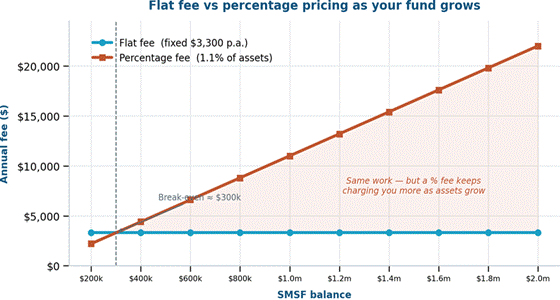
Same compliance work – but a percentage fee keeps charging you more as your fund grows.
As the chart shows, the two pricing models cross over at around $300,000. Below that, a percentage fee can look cheap. Above it, a percentage fee quietly becomes one of the biggest – and most avoidable – drags on your retirement savings. On a $1.5m fund, a 1.1% fee is roughly $16,500 a year versus a flat fee model. That’s real money compounding out of your future.
For years the rule of thumb was that a fund needs around $200,000+ to be cost-effective versus a retail or industry fund – but that’s only half the story. The real value of an SMSF isn’t just low fees; it’s control, flexibility and strategy – the ability to hold property, run tailored pensions, and align your super with your broader wealth plan. Pair that with fixed-fee pricing and the numbers can stack.
An SMSF shouldn’t cost you a mystery. Setup is a modest one-off, the annual compliance is predictable, and the audit is simply the price of playing by the rules. The single biggest lever on your long-run cost is the pricing model – and a fair, flat fee means you keep the upside of your own hard work.
Want to know exactly what your fund should be paying? Explore our SMSF Accountants Brisbane | Fixed-Fee Setup & Compliance, or jump over to our contact page and call us on (07) 3124 0244 for a straight-talking, fixed-fee quote.
Luke Gozzard | CPA
Partner
SMSF Specialist
T +617 3124 0244 | E luke@empireaccountants.com.au
Leonard Jiang | CA, CTA, DFP
Partner
Tax Specialist
T +617 3124 0244 | E leonard@empireaccountants.com.au

Starting a company is an exciting step, but the order in which you register your business and make purchases can affect your GST claims. If you have paid for equipment or start-up expenses personally before your company was incorporated, you may be wondering whether those GST credits are lost.

Starting a business can be equally exciting and daunting. What may have begun as a side hustle can grow into something much bigger - and
eventually, you may reach the point where doing everything yourself is no longer sustainable.
For many small business owners, that next stage of growth brings an important question: should you hire your first employee or engage an
independent contractor?

For many small business owners, a new car is both a practical business tool and a significant financial commitment. One of the first questions we are often asked is: “Should I buy the car through my company, or should I own it personally?”