07 3124 0244 07 3124 0244

How to Use an SMSF to Buy Your Business Premises in Brisbane : The 2026 Compliance Guide

Posted 16 Sep

How to Use an SMSF to Buy Your Business Premises in Brisbane : The 2026 Compliance Guide

Disclaimer: This content is general in nature and current as at August 2026. It does not consider your personal financial circumstances and is not financial product or legal advice. SMSF borrowing rules changed on 10 August 2026 – please seek advice from a SMSF accountant and a licensed adviser before acting.


With the 22 Olympics on the horizon and a decade of infrastructure spend rolling into the River City, Brisbane commercial property is having its moment in the sun. And for business owners, one of the smartest wealth moves on the table is buying your own business premises inside your Self-Managed Super Fund (SMSF) – then leasing it back to your business. Rent you’d otherwise pay a landlord ends up building your retirement nest egg instead. Genuis!

But – and it’s a big but – the rules changed on 10 August 2026. So before we get to the good stuff, let’s clear up exactly what you can and can’t do now.

First, the big 2026 rule change

On 10 August 2026, the Treasury Laws Amendment (Tax Reform No. 1) Act 2026 commenced, inserting a new condition into section 67A(2) of the Superannuation Industry (Supervision) Act 1993.

In plain English: from that date, if your SMSF wants to borrow to buy real property, that property must be business real property. New borrowing to buy residential investment property inside super is off the table.

The headline in one line: SMSFs can no longer take out a new Limited Recourse Borrowing Arrangement (LRBA) to buy residential property – but borrowing to buy your business premises is very much alive and well.

A few things this didn’t do, which are worth mentioning:

  • LRBAs are not banned. Your SMSF can still borrow – just not for residential property.
  • Existing loans are grandfathered. If your fund already held residential property under an LRBA before 10 August 2026, nothing changes and there’s no forced sale.
  • Contracts exchanged in time are protected. A binding contract signed before 10 August 2026 is preserved, even if it settled later.
  • Cash purchases are unaffected. An SMSF with sufficient liquidity can still buy property outright – the change only touches borrowing.

‘Business real property’ ≠ ‘commercial property’

Here’s the trap that’s catching people out, and it’s exactly the kind of detail that separates a clean strategy from a compliance headache. Everyone’s saying “commercial property is still fine” – which is broadly true, but it’s not the legal test. The test is business real property (BRP).

BRP generally means land and buildings used wholly and exclusively in one or more businesses. That distinction matters:

  • A commercially-zoned property that isn’t actually used in a business may not qualify as BRP.
  • A property that looks residential can still qualify as BRP if it’s used wholly and exclusively in a business (e.g. a converted Queenslander run entirely as a medical practice).
  • Primary production land with a home on it can still be BRP if the dwelling sits on no more than 2 hectares and the main use isn’t private/domestic.

And it’s not a one-off test. The asset must be BRP when you enter the LRBA and remain BRP for the entire life of the loan.

If it stops being business real property partway through, the fund can fall foul of the borrowing rules. So ‘wholly and exclusively in a business’ is the phrase to imprint into memory.

Why business owners love this strategy

  1. Pay rent to yourself. Your business pays market rent to your SMSF instead of an external landlord – building your super, not someone else’s.
  2. The related-party exception. Unlike residential, your SMSF can buy BRP from you or your business, and lease it back to your own business – provided it’s at genuine market terms.
  3. Concessional tax. Net rent is taxed at just 15% in accumulation – and potentially 0% once the fund is in pension phase, where a well-timed sale can dramatically cut CGT. The recent changes to CGT does not affect super! The CGT discount is still on the cards.
  4. Asset protection. Holding the premises in super can help quarantine a valuable asset from the trading risks of the business. When is comes to asset protection, super is king!

Borrowing for business premises – the LRBA

Don’t have the full purchase price sitting in cash? The SMSF is the only structure the ATO allows to borrow to acquire property – via a Limited Recourse Borrowing Arrangement (LRBA).

The premises are held in a separate holding (bare) trust, and if the loan ever defaults, the lender’s recourse is limited to that one asset – protecting the rest of your fund.
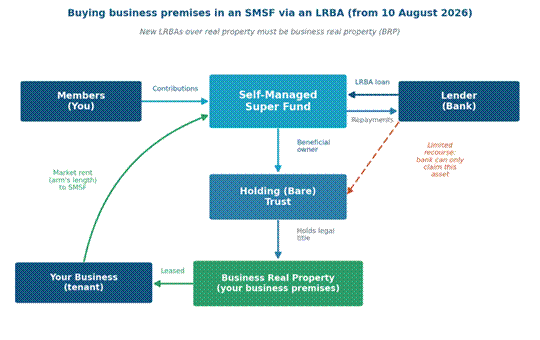
How an LRBA works for business premises – from 10 August 2026, new LRBAs over real property must be business real property.

Your step-by-step compliance roadmap

  1. Confirm it’s genuine BRP – is the property used wholly and exclusively in a business? Get this assessed before you commit.
  2. Check your investment strategy and liquidity – can the fund cover rates, outgoings and repayments?
  3. Set up the holding (bare) trust and corporate trustee before you sign anything – timing here is critical.
  4. Arrange LRBA finance early – SMSF lenders use lower loan-to-value ratios (often ~65–70%) and may want personal guarantees.
  5. Sign the contract in the correct name – the trustee of the holding trust, not you personally (or even the SMSF – which a lot of other non-SMSF specialist accountants get wrong!)
  6. Put a proper market-rent lease in place – arm’s length terms, paid on time, documented, and reviewed regularly and market adjusted.
  7. Keep it BRP for the life of the loan – if the tenant business moves out, re-let it to another business promptly and keep records immaculate for the annual audit.

Common SMSF traps to avoid

  • Assuming “commercial = allowed” – if it’s not business real property, a new LRBA can’t touch it.
  • Letting the premises drift out of business use mid-loan (e.g. converting to residential) – that can breach the borrowing rules.
  • Using borrowed LRBA funds to improve the asset (e.g. a major fit-out or extension) – you can repair and maintain, but you can’t fundamentally change the asset while it’s geared.
  • Charging your own business mates’ rates – rent must be at genuine market value, every time.

What if you still want residential in super?

You’ve still got options – they just don’t involve new borrowing. Your SMSF can buy residential property outright with cash if it has the liquidity, and any residential LRBA already in place before 10 August 2026 simply continues as grandfathered. If that’s you, hold tight and get advice before refinancing.

Conclusion

The 10 August 2026 changes closed one door and left another wide open. Residential borrowing in super is done – but buying your business premises through your SMSF remains one of the most powerful, tax-effective wealth strategies available to Brisbane business owners.

Get the business real property test right, nail the structure and timing, and keep the paperwork immaculate – and it’s a fortress.

Thinking about moving your business premises into super – or worried about an existing arrangement post-August 2026?

Explore our SMSF Accountants Brisbane page to learn more, or head to our contact page and call us on (07) 3124 0244 – let’s make sure your Brisbane property play is built on solid compliance ground. 

Luke Gozzard

Co-Authored by Luke Gozzard | CPA

Partner & SMSF Specialist at Empire Accountants

T +617 3124 0244 | E luke@empireaccountants.com.au

Luke co-founded Empire Accountants after beginning his career as an Airforce technician and later transitioning to financial services. He is a Certified Practising Accountant (CPA) who holds a Bachelor of Business in Accounting and Financial Planning, and he is deeply motivated by helping clients understand their numbers to build better businesses.

View Professional Profile & Contact Luke
Leonard Jiang

Written by Leonard Jiang | CA, CTA, DFP

Partner at Empire Accountants

T +617 3124 0244 | E leonard@empireaccountants.com.au

Leonard joined Empire in 2016 and is a fully qualified Chartered Accountant (CA) and Chartered Tax Advisor (CTA). He combines strategic financial planning with a deep passion for financial education, delivering practical, sound advice that helps small business owners confidently turn their sparks into highly scalable realities.

View Professional Profile & Contact Leonard

Related News

Company Car vs Personal Car: Which Is More Tax Effective?

For many small business owners, a new car is both a practical business tool and a significant financial commitment. One of the first questions we are often asked is: “Should I buy the car through my company, or should I own it personally?”

QBCC Annual Reporting: What Contractors Need to Know

For Queensland builders, tradies and construction businesses, QBCC financial compliance is about more than completing another annual form. The financial position of a licensed business can affect its ability to continue operating under its contractor licence and take on work.

Empire Partner in Business Feature: Setlr Buyers Agents

We’re excited to introduce our latest Partner in Business, Simon Clarke, Director of Setlr Buyers Agents. Simon and his team understand that buying property isn’t just about finding the right home or investment. It’s about having the right advice, local knowledge and support to make a confident, well-informed decision.