Outgrown Your Accountant? 5 Steps to Seamlessly Switch Your SMSF Provider
Posted 25 Aug


Posted 25 Aug
|
Disclaimer: This content is general in nature and for informational purposes only.
It does not consider your personal financial circumstances and is not financial product advice. Please seek advice from a licensed
financial adviser and an SMSF accountant before acting. |
Let’s be honest –
You are sick of tired of being the side-piece! Your Self-Managed Super Fund (SMSF) has grown up, your strategy has become more sophisticated, and yet you’re still getting the same service (and the same painfully late tax return) you got back when your fund had two term deposits and a hopeful attitude that your retirement was set.
Here’s the good news: switching your SMSF accountant is nowhere near as painful as
people imagine. In fact, most trustees are surprised at how amazingly smooth it is. So today, let’s pull back the walls on the 5-step
process to switch providers without your fund skipping a beat.
If a few of these are hitting a little too close to home, it might be time to shop around:
The number one reason trustees stay put is fear – fear that switching means winding up the fund, selling assets, or triggering a tax bill. None of that is true.
You are simply changing who prepares the compliance, not the fund itself. Same fund, same ABN, same trustee, same investments. There is no capital gains tax (CGT) event, no rollover, and no need to sell a single asset. Think of it as changing your mechanic – the car stays exactly where it is.
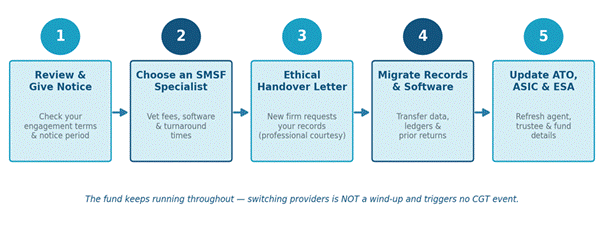
The 5-step switch – your fund keeps running the entire time.
Step 1 – Review your engagement & give notice
Dig out your current engagement letter and check the notice period and whether any fees are outstanding. A quick, polite email to your current accountant letting them know you’re moving on is all that’s needed – no awkward break-up speech required.
Step 2 – Choose the right SMSF specialist
Not all accountants are created equal. Ask the important questions: Are you SMSF specialists? Do you charge a fixed fee or a percentage of assets? What software do you use, and what’s your typical turnaround? Are you put into an online system with no communication or someone you can actually talk to? The right fit should feel like an upgrade, not a lateral move.
Step 3 – The ethical handover letter
Once you sign up, your new firm sends what’s known as an ‘ethical letter’ to your old accountant – a professional courtesy requesting your records and confirming there’s no reason you shouldn’t move. You barely lift a finger; the accountants handle the handshake.
Step 4 – Migrate your records & software
Your new firm collects the essentials – the trust deed, prior-year financials and tax returns, the latest signed audit report, member statements and investment register. If your fund is being brought onto modern SMSF software, your data is migrated across so nothing falls through the cracks.
Step 5 – Update the ATO, ASIC & your ESA
Finally, the housekeeping: your new firm is appointed as your tax agent, ASIC details for a corporate trustee are updated, and your
Electronic Service Address (ESA) is confirmed so your fund keeps receiving contributions and rollovers. Done – you’re officially in better
hands.
Typically weeks, not months – and the best time to switch is early in the financial year or right after your annual return is lodged, so
nothing is left half-finished. The heavy lifting sits with the accountants; your job is mostly to say ‘yes, go ahead’.
Loyalty is a wonderful thing – but not when it’s costing you money, strategy and sleep. If your SMSF has outgrown your current SMSF administrators, switching is simpler, safer and cheaper than you think.
Ready to make the move? Take a look at our SMSF Accountants Brisbane | Fixed-Fee Setup & Compliance, or head straight to our contact page and give us a call on (07) 3124 0244 – let’s get your fund into gear.



Rising business costs can quickly squeeze profit. For many business owners, that creates an uncomfortable question: do I put my
prices up and risk losing customers, or absorb the higher costs and hope things improve?
Learn how to review your margins, pricing and break-even point before deciding whether to raise prices.

“So… how much does an SMSF actually cost me?” It’s hands-down the most common question we get from trustees, and the honest answer is: it depends on who you ask – and, crucially, on how they charge you. Let’s cut through the noise and put some real numbers on the table.

Starting a company is an exciting step, but the order in which you register your business and make purchases can affect your GST claims. If you have paid for equipment or start-up expenses personally before your company was incorporated, you may be wondering whether those GST credits are lost.